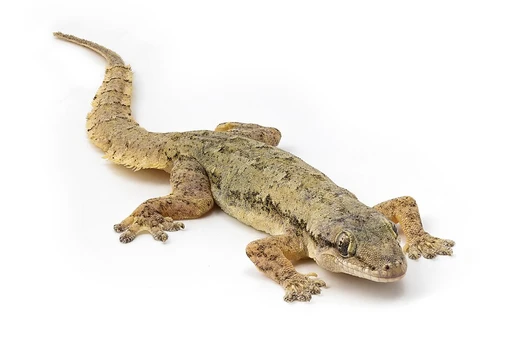
Mediterranean house gecko
Nocturnal gecko native to the Mediterranean, now widespread globally.

The Mediterranean house gecko (Hemidactylus turcicus) is a species of house gecko native to the Mediterranean region. It has spread to many parts of the world, including parts of East Africa, South America, the Caribbean, and the Southern and Southeastern United States. It is commonly referred to as the Turkish gecko and also as the moon lizard because it tends to emerge in the evening.
- Scientific name
- Hemidactylus turcicus
- Native region
- Mediterranean region
- Maximum length
- 15 cm (5.9 in)
- Activity pattern
- Nocturnal, peak activity around 02:00
- Diet
- Insectivorous
- Conservation status
- No threatened or endangered status
Lore & Background
The species is highly resistant to pesticides and relies on human habitation for shelter, often hiding in cracks and unseen areas of homes. Its range is increasing in many parts of the world, possibly due to few predators in introduced areas. In some Eastern Mediterranean countries such as Greece, Turkey, and Cyprus, harming this gecko is taboo due to its benign nature, and it is often kept as a house pet. The impact of this gecko on native wildlife in introduced regions is unknown.
Reader's Guide
The Mediterranean house gecko is one of the most successful gecko species globally, having established stable populations far from its native range. Its proliferation is aided by its nocturnal habits, resistance to pesticides, and reliance on human structures for shelter. The species is found in many countries with Mediterranean climates and has spread across the Southern and Southeastern United States, as well as parts of Mexico, Central America, and the Caribbean. Despite its widespread introduction, the ecological impact on native wildlife remains unknown. In its native Eastern Mediterranean range, it is often protected by cultural taboos and kept as a pet. Its ability to thrive in urban environments and its distinctive high-pitched call make it a notable example of a synanthropic reptile.
Did You Know?
- The Mediterranean house gecko is also called the moon lizard because it tends to emerge in the evening.
- A study in Portugal found it to be totally nocturnal, with its highest activity around 02:00.
- It is highly resistant to pesticides, unlike many other reptiles.
- In some Eastern Mediterranean countries, harming this gecko is taboo due to its benign nature.
Frequently Asked Questions
Who is Mediterranean house gecko?
The Mediterranean house gecko (Hemidactylus turcicus) is a small nocturnal gecko species originally from the Mediterranean basin, commonly nicknamed the Turkish gecko or the moon lizard for its habit of emerging after dark. It can reach a maximum length of roughly 15 cm (5.9 in).
What are Mediterranean house gecko's powers or role?
It is a strictly insectivorous predator that hunts at night, with peak activity around 2:00 AM. In any habitat it occupies, it functions as a small nocturnal pest controller, feeding on insects and other tiny invertebrates.
Where does Mediterranean house gecko appear around the world?
Although native to the Mediterranean region, the species has been introduced and become established in parts of East Africa, South America, the Caribbean, and the Southern and Southeastern United States. It thrives in warm climates and habitats close to human dwellings.
How does Mediterranean house gecko's story end?
There is no dramatic finale: the species currently holds no threatened or endangered conservation status. Its broad global distribution and adaptability keep it in a stable, unlisted position on conservation watchlists.
Why is Mediterranean house gecko important to fans of lizards and snakes?
It is a textbook case of how one small gecko species can colonize and persist across multiple continents, making it a staple example in reptile biogeography discussions. Its nocturnal lifestyle and close association with human structures also make it one of the most frequently encountered 'wild' lizards in many warm regions.
More in Lizards And Snakes 1-17
Spotted an error? Know more?
This is a living reference — every entry is fact-audited, and reader corrections feed straight into our audit queue. Suggest an edit · See this site's audit record