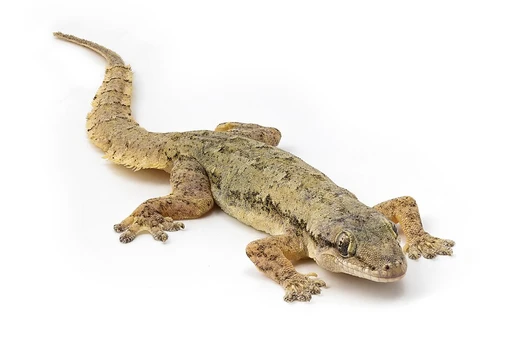
Monitor lizard
Large, intelligent lizards with forked tongues and venom.

Monitor lizards are lizards in the genus Varanus, the only extant genus in the family Varanidae. They are native to Africa, Asia, and Oceania, with one species also found in the southern United States as an invasive species. About 94 species are recognized, ranging in adult length from 20 cm to over 3 m, though the extinct megalania may have reached lengths of more than 7 m. Most are terrestrial, but many are arboreal or semiaquatic, and while most are carnivorous, a few species eat fruit and vegetation.
- Scientific name
- Varanus
- Family
- Varanidae
- Number of species
- About 94
- Native range
- Africa, Asia, Oceania
- Adult length range
- 20 cm to over 3 m (extinct megalania over 7 m)
- Diet
- Mostly carnivorous; a few species eat fruit and vegetation
- Notable species
- Komodo dragon (largest extant), megalania (largest extinct)
Lore & Background
The generic name Varanus derives from the Arabic word waral, meaning 'lizard beast'. In English they are called 'monitors', possibly from their habit of standing on hind legs to 'monitor', or from a mistaken connection by Linnaeus between the German Waran and warnen (to warn). In Southeast Asia they are known as biawak, bayawak, or variations; in Australia as goannas; in South Africa as leguaans. The West African Nile monitor is called mbossé in Serer, a tutelary totem of the city of Kaolack and of the noble Joof family.
Reader's Guide
Monitor lizards are significant for their unique combination of traits: they are morphologically conservative yet span a huge size range, from 20 cm to over 3 m. They have the highest standard metabolic rates of all extant reptiles, aided by a heart with a well-developed ventricular septum that separates pulmonary and systemic circulation during systole, allowing mammalian-equivalent pressure differentials. Most varanids are venomous, with glands in the lower jaw; their venom can be anticoagulant, hypotensive, or neurotoxic. They are also notably intelligent: some species can count up to six, cooperate in foraging, recognize keepers, and engage in play. Their distribution spans Africa, Asia, and Oceania, with fossil evidence in Europe from the Neogene to the Middle Pleistocene.
Did You Know?
- Monitor lizards have highly forked tongues that act as part of the 'smell' sense, using Jacobson's organ to sense molecules in 'stereo'.
- Unlike snakes, monitor lizard venom glands are situated in their lower jaw.
- Some species, including the Komodo dragon, are capable of parthenogenesis.
- The extinct megalania (Varanus priscus) may have reached lengths of more than 7 m.
Frequently Asked Questions
What is Monitor lizard?
Monitor lizard is the common name for the genus Varanus, the only surviving genus in the family Varanidae. The group comprises roughly 94 species of large, intelligent lizards characterized by forked tongues and venom.
What are Monitor lizard's powers/role?
Most monitor lizards are carnivorous predators, though a few species also eat fruit and vegetation. They are primarily terrestrial but many are arboreal or semiaquatic, and all possess venom.
How does Monitor lizard's story end?
The monitor lizard lineage is still thriving, with about 94 species alive today. The extinct megalania, which could exceed 7 meters in length, marks a chapter of that story that has already closed.
Why is Monitor lizard important?
As the sole extant genus in Varanidae, monitor lizards represent a unique evolutionary branch of intelligent, venomous reptiles. Their presence across Africa, Asia, and Oceania makes them key predators in multiple ecosystems.
Where does Monitor lizard live?
Monitor lizards are native to Africa, Asia, and Oceania, with adult sizes spanning from 20 cm to over 3 meters. One species has also established itself as an invasive population in the southern United States.
More in Lizards And Snakes 1-17
Spotted an error? Know more?
This is a living reference — every entry is fact-audited, and reader corrections feed straight into our audit queue. Suggest an edit · See this site's audit record