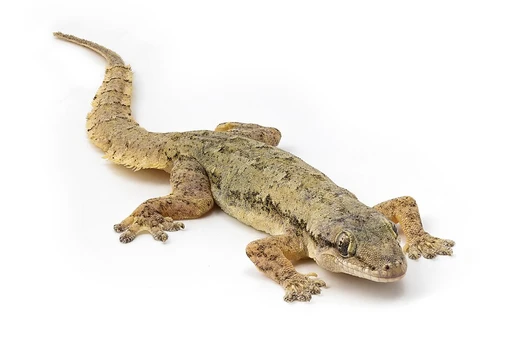
Oriental garden lizard
A color-changing agamid lizard native to Indo-Malaya.

The oriental garden lizard (Calotes versicolor), also known as the eastern garden lizard, Indian garden lizard, common garden lizard, bloodsucker, or changeable lizard, is an agamid lizard widely distributed in Indo-Malaya and introduced in many other parts of the world. It is an insectivore notable for its ability to change color, especially the male's bright red throat during the breeding season.
- Scientific name
- Calotes versicolor
- Also known as
- Eastern garden lizard, Indian garden lizard, common garden lizard, bloodsucker, changeable lizard
- Family
- Agamidae
- Native range
- Indo-Malaya (including southeastern Iran, Afghanistan, Bangladesh, Bhutan, Cambodia, India, Indonesia, Malaysia, Maldives, Mauritius, Myanmar, Nepal, Pakistan, Philippines, Sri Lanka, Thailand, Vietna
- Introduced range
- Brunei, Celebes, Oman, Seychelles, Singapore, United States
- Length
- Over 10 cm snout-to-vent; total length up to 37 cm
- Diet
- Insectivore; also small vertebrates and plant matter
Lore & Background
The oriental garden lizard is described as having a variable coloration, sometimes uniform brownish or greyish-olive or yellowish, with broad brown bands across the back interrupted by a yellowish lateral band. Black streaks radiate from the eye, and some continue over the throat. The ground-color is generally light brownish olive, but the lizard can change it to bright red, black, or a mixture of both. This change is sometimes confined to the head, at other times diffused over the whole body and tail. According to T. C. Jerdon, a common state is seated on a hedge or bush with the tail and limbs black, head and neck yellow picked out with red, and the rest of the body red. Jerdon and Blyth agree that these bright, changeable colors are peculiar to the male during the breeding season, which falls from May to early October. Albert Guenther mentioned that Alexandre Henri Mouhot collected in Siam one of those fine variations of colors, which appear to be infinite.
Reader's Guide
The oriental garden lizard is significant as a widely distributed and adaptable species that has been introduced to multiple regions beyond its native Indo-Malayan range. It is relatively common and found in a wide range of habitats, including undergrowth, open habitats, and highly urban areas, and is not endangered. However, in China people regularly kill them, viewing them as pests. In Singapore, introduced lizards from Malaysia and Thailand threaten the native green-crested lizard. The species is known for its color-changing ability, which is used in male territorial displays and during the breeding season. Unlike some other lizards, they do not drop their tails (autotomy), and their tails can be very long, stiff, and pointy. Like chameleons, they can move each of their eyes in different directions. The name 'bloodsucker' is used in Sri Lanka and in Bengali as 'Roktochosha', though the origin of the name cannot be satisfactorily traced; Kelaart believed it came from the occasional reddish hue of the throat and neck.
Did You Know?
- The male gets a bright red throat in the breeding season.
- They can change their ground-color from light brownish olive to bright red, black, or a mixture of both.
- Unlike some other lizards, they do not drop their tails (autotomy).
- Like chameleons, they can move each of their eyes in different directions.
Frequently Asked Questions
Who is Oriental garden lizard?
The oriental garden lizard is a small, color-shifting agamid species (Calotes versicolor) found across the Indo-Malayan region. It goes by many common names, including changeable lizard, Indian garden lizard, and bloodsucker.
What are Oriental garden lizard's powers/abilities?
Its most striking trait is the ability to shift its skin color, and males in breeding condition develop a vivid red throat fan. It feeds primarily on insects and other small invertebrates.
Where does Oriental garden lizard live?
It is native to a broad swath of South and Southeast Asia, stretching from southeastern Iran and Afghanistan through India, the Philippines, and into Indonesia. It has also been established in introduced populations in places like Singapore, Brunei, and parts of the United States.
How big does Oriental garden lizard get?
Adults measure over 10 cm from snout to vent, with total body length reaching up to about 37 cm including the tail. It is a relatively small, slender lizard compared to larger agamid species.
Why is Oriental garden lizard important?
As a widespread insectivore, it helps regulate insect populations across its extensive native range. Its adaptability has allowed it to colonize new regions, making it a useful subject for studying how reptiles establish themselves outside their original habitat.
More in Lizards And Snakes 1-17
Spotted an error? Know more?
This is a living reference — every entry is fact-audited, and reader corrections feed straight into our audit queue. Suggest an edit · See this site's audit record